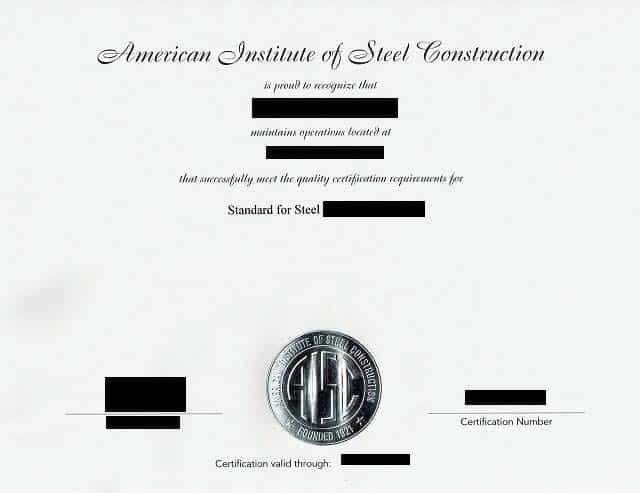
The complete AISC quality program provides Fabricator and Erector policies, procedures and forms that enable compliance with the 207-25 standard (was 207-23).
We continuously improve documents in the kit according to successfully certified User feedback and brainstorming sessions we provide at no charge to find ways and means to integrate requirements needed by Clients and Responsible Authorities. Such as best practice for 3D Building Information Modeling (BIM) according to AISC 303.
Conformance with the AISC standard means your Company is committed to continuous improvement and continuing maintenance of its quality management system using practical steps that support quality policies to meet Customer, industry, and contract requirements.
Click on demo link below to evaluate the contents of the complete kit, which you can use in your business operation according to license terms and conditions.
Browse and purchase the complete AISC Quality Program Kit
(only need an update?)
AISC Quality Program Kit, $297
Browse the PDF Demo AISC Quality Program Kit
Contents of the Complete kit (text file)
The kit now has dedicated Erector and Fabricator Work Procedures instead of one generic procedure.
The quality policy defines the purpose and context of your Company and its strategic direction, which includes a framework for setting quality objectives and pays particular attention to satisfying applicable requirements according to the Company’s commitment to continuously improve the quality management system.
The AISC quality program is designed to satisfy the AISC standard 207-25 (was 207-23), contract documents and referenced standards.
Compliance with the standard means your Company will ensure that necessary procedures and instructions are readily available to personnel that are responsible for compliance with contract requirements, and to Customer and/or Regulatory Agency Representatives as a required documented part of the work process. Documents in the kit are structured from top-down: Quality Manual, Supporting Documents, Work Instructions and Quality Records.
Building Information Modeling:
The AISC 303 Code of Standard Practice for Steel Buildings and Bridges addresses digital verification by providing guidelines for the use of digital models in the review and approval process as an alternative to traditional paper drawings. The AISC quality program includes reference to best practice for 3D BIM document approvals.
The Code of Standard Practice itself explicitly includes expanded provisions and clearer guidelines for model-based deliverables, reflecting the industry’s shift toward digital delivery methods.
The Code of Standard Practice was revised to include generic language addressing contracts that use drawings, models, or a combination of both. A separate guideline, the AISC Guide to Model Review and Approval, was also prepared to clarify this process.
Key aspects of using digital models for verification include:
- Alternative to Drawings: Digital models can be used as an alternative to traditional shop and erection drawings for review and approval purposes, provided this is outlined in the contract documents.
- Best Practices: The AISC guide offers best practice guidelines for what to expect when using this evolving process within the industry, but it does not provide a comprehensive or contractual outline.
- Software Integration: Software tools are widely used to perform calculations, automate checking of member and connection capacities, and visualize structural behavior in compliance with the related AISC 360-22 Specification. Engineers use these tools for efficiency but are expected to apply professional judgment and verify software outputs.
Digital Access and Verification of the Document:
The AISC 303 document itself is available for free digital download as a PDF from the AISC website.
AISC also offers a subscription-based digital edition service with built-in features that facilitate review and verification:
- Personalized Watermarks: Documents include personalized watermarks and other security features.
- Annotation Tools: Users can utilize annotation tools like sticky notes, highlighting, underlining, and sketching for review purposes.
- Searchable Text and Bookmarks: The digital format allows for searchable text and built-in contents bookmarks, aiding in quick reference and verification of specific clauses.
- Offline Access: The ability to temporarily save a local copy in a browser for offline use is also available through the digital platform.
The ConsensusDocs 301 BIM Addendum offers significantly more detailed information about the protocols, roles, and responsibilities for 3D model approval than the general AISC Code of Standard Practice.
The AISC 303 references external documents like ConsensusDocs 301 to acknowledge that a comprehensive contractual framework for BIM is necessary and exists, but it does not reproduce that level of detail within its own code. The AISC quality program provides best practice for 3D BIM document approvals.
How ConsensusDocs 301 Helps with 3D Model Approval:
The ConsensusDocs 301 document is specifically designed as a legal framework to manage the complexities of Building Information Modeling (BIM) data and collaboration. Key features related to 3D model approval include:
- Contractual Framework for BIM: It is designed to be an addendum to primary construction agreements (Owner-Contractor, Owner-A/E, etc.), making the use of models a formally defined part of the contract documents.
- BIM Execution Plan (BxP): A key requirement of the addendum is the creation of a detailed BxP. This plan is where project stakeholders align on technical and legal aspects, including:
- Level of Development (LOD): Specifies the appropriate level of detail and information for model elements at different project milestones, which directly dictates what constitutes an “approvable” model at each phase.
- Data Sharing Protocols: Defines how and when model data can be relied upon, mitigating disputes during the approval and coordination process.
- Roles and Responsibilities: Clearly defines which party (architect, engineer, contractor, etc.) is the Information Manager (IM) responsible for managing the full design model and the approval process.
- Permitted Reliance: The addendum clarifies that if models are included as contract documents, project participants may rely upon the accuracy of information in those models, a critical aspect of approval and risk allocation.
- Conflict Resolution: The document provides a structure for managing conflicts between the model and traditional 2D drawings if both are used, which is a common issue during review.
We can help your Company achieve certification that is needed for steel construction business opportunities using the comprehensive AISC quality program.
AISC 207-25 Update Kit, $147
For Users of the old revision Complete kit, use the following docs to update to the latest standard.
Contents of the Update kit: (manuals are available as standalone docs)
Changes in 207-25
$97 Erector / $147 Fabricator Quality Manuals
Definitions and Abbreviations Procedure
Training Procedure
Complementary Docs
Tech-support for your Company’s AISC quality program is no charge by phone and email, and has no expiration. Visit with us during your Office hours from 6:00am to 6:00pm, even on weekends.
JnF Specialties: A 55-Year RQA Legacy
Founded by Jennifer and Frank, JnF has been a cornerstone of practical quality since 2001. Frank Elias began his journey in 1969 at Edcliff Instruments, later serving as Quality Manager for KIM and Associates, then as Responsible Quality Authority for Eagle-Picher Technologies.
The “Until…” Validation: This expertise was terminally validated during the 2003 NASA Recovery Initiative, where Frank successfully closed 36 NASA-SAC findings. Today, this rigor is anchored in every resource in the Quality Manager Toolbox.
Priceless Bonus: No-Charge RQA Mentorship & Tech-Support
Live Mentor/Support: 6am – 6pm CONUS (Mon–Sun)
Expert support for your safety net.
Email Us:

Call Us:
JnF Home | Efficient QMS™ Digital Quality System | LinkedIn Authority